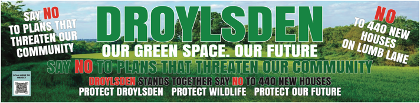
Help Save Our Green Space & Protect Our Environment
*
Help Save Our Green Space & Protect Our Environment *
Protect Littlemoss. Preserve Our Heritage. Defend Nature for Future Generations.
Littlemoss is more than open land. It forms part of a wider ecological network that provides habitat, shelter, feeding grounds and movement corridors for wildlife. Evidence from environmental and conservation bodies shows that habitat loss and fragmentation are among the most significant threats to biodiversity in the UK. When green spaces are replaced by development, wildlife populations can become isolated,habitats are reduced in size, and species may struggle to move, feed and reproduce. [forestrese...rch.gov.uk], [forestrese...rch.gov.uk]
The UK is already one of the most nature-depleted countries in the world. The State of Nature Report 2023 found that UK species havedeclined by an average of 19% since 1970, with many plants, pollinators and other wildlife continuing to face significant pressures fromhabitat loss and development. [stateofnature.org.uk]
Green Belt land such as Littlemoss can play an important role in maintaining biodiversity by connecting habitats and providing space where nature can thrive. Natural England's evidence highlights the importance of protecting and connecting nature-rich spaces, noting thatlarger, well-connected habitats are more resilient and better able to support wildlife, especially as species adapt to climate change. [gov.uk], [gov.uk]
Beyond wildlife, access to nature delivers substantial benefits for people and communities. Natural England's research shows that green spaces close to home support physical health, mental wellbeing, community cohesion and quality of life. These benefits are particularlyimportant as urban areas continue to grow and open green spaces become increasingly scarce. [naturaleng...log.gov.uk], [gov.uk]
For these reasons, we believe any proposal for development at Littlemoss must be subject to rigorous ecological scrutiny and must fullyconsider not only the immediate loss of habitat, but also the long-term consequences for biodiversity, wildlife connectivity, environmentalresilience and community wellbeing.
Once a green space is built upon, it can never truly be replaced. Protecting Littlemoss is not simply about preserving land. It is about safeguarding nature, local heritage and the environmental legacy we leave to future generations.
We are the first generation to fully understand the consequences of biodiversity loss, and the last generation with the power to prevent it. Littlemoss is part of that responsibility. As custodians of this landscape, we owe it to futuregenerations to protect it.